Coaches for school trips and educational visits
A school trip gets planned twice: once for the learning, once for the road. This page covers the road side. Seat belts, set-down points and the checks a school usually keeps on file.
Consent and approval
The Department for Education expects higher-risk visits to have a written risk assessment, a proper plan, and sign-off by a headteacher or governors who know what the trip involves. Parents of nursery-age children always give written consent. Past nursery age, consent forms are normally reserved for trips assessed as higher risk. Your own policy says which applies.
Staff may drive a school minibus on a car licence only when there is no hire or reward. Once the school pays for a vehicle with a driver, that driver needs D1 or D entitlement and the vehicle must run under a PSV operator's licence.
Belts on board
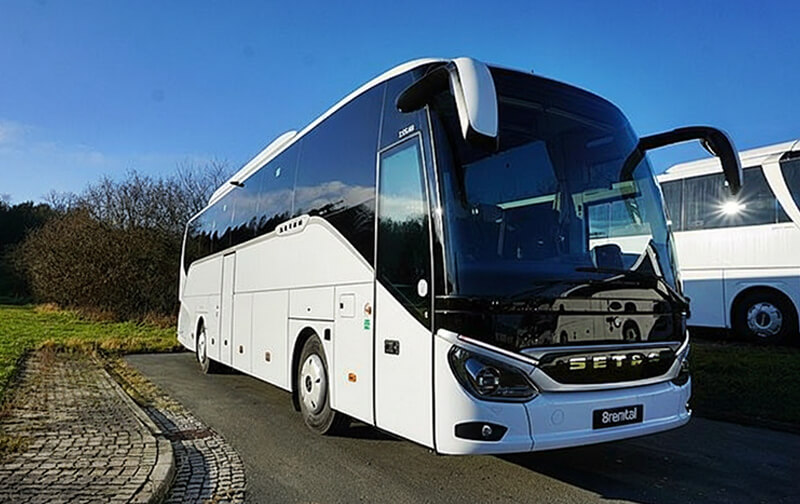
Coaches in service since 1 October 2001 have a belt at every forward- and rearward-facing seat. Pupils aged 14 and over must wear one where fitted, and passengers have to be told this, often with a sign, a spoken reminder or a video. Staff should still walk the aisle before moving off.
Minibuses are stricter for young children. From age 3 until a child is 135 cm tall or turns 12, a child restraint is used, falling back to the adult belt only when none is on board. Tell the operator how old the pupils are.
Rules that apply
- A school must always get written consent for nursery-age children; for older pupils it is usually needed only for trips with a higher level of risk assessment
- Coach passengers aged 14 and over must wear a seat belt where fitted, and must be told to, usually by a notice, announcement or film
- School staff may drive a minibus on a car licence only when it is not for hire or reward; driving one commercially needs D1 (PCV) entitlement and a PSV operator's licence
Historic cities are the hardest stops
York: nothing above 16 seats goes inside the walls. Set down at a coach park or at the rendezvous points on Leeman Road, Fawcett Street and Foss Bank. Oxford has three set-down bays but no coach parking in the centre, so long stays go to Redbridge Park & Ride. In Cambridge, coaches drop off on Queen's Road and park at Madingley Road.
Count pupils for the return where the coach can legally stop, not at the museum's front door.
Questions
Does the coach have to be wheelchair accessible?
For a private trip, no rule requires it, so ask for an accessible vehicle. Closed-door home-to-school services differ: non-PSVAR coaches run on them only under an exemption, and those exemptions are valid 11 August 2026 until 10 August 2030.
Will we pay a Clean Air Zone charge?
Only if the vehicle misses the standard, which is Euro VI for coaches. Sheffield offers a local exemption for vehicles contracted with schools for educational trips, applied for in advance.
Who supervises the pupils on board?
The school. Ratios and seating follow your policy and risk assessment, so seat staff where they can see every row.
Cities
Vehicles
- Full-size coach — 49-57 seats
- Midi coach — 29-35 seats
- Minibus — 9-16 seats
- Executive Sprinter-style minibus — 9-16 seats
- Executive car (saloon or MPV) — 1-3 seats
- Wheelchair-accessible minibus — Varies by layout; wheelchair positions replace seats seats