Full-size coach with a driver
A full-size coach is the usual choice for groups of about 35 and up. Expect roughly 49 to 57 seats and underfloor lockers. The exact layout depends on the vehicle the operator sends.
Seats, toilet and luggage
Toilet or extra seats: that is the trade-off. Touring coaches usually come as 53- or 57-seaters with a toilet on board, or 61-seaters without one. If the group needs one, say so, because it takes the space of several seats. Suitcases go in the underfloor lockers, which is why coaches suit airport runs and multi-day tours.
Seat numbers on a quote are typical until the operator names the vehicle.
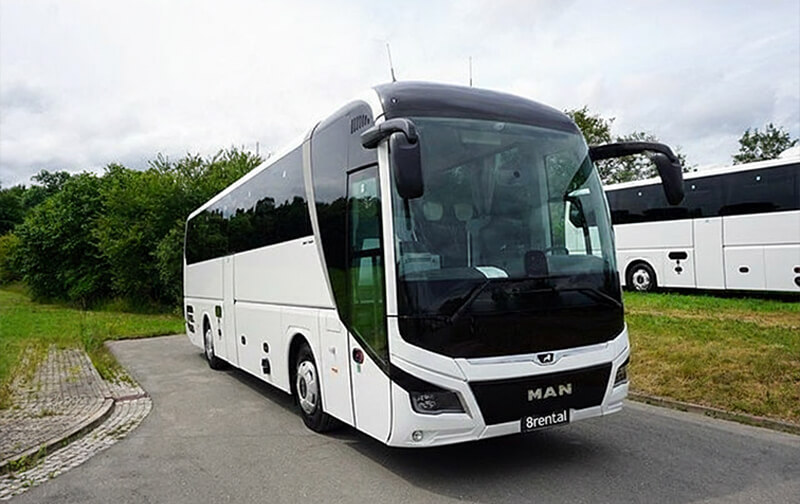
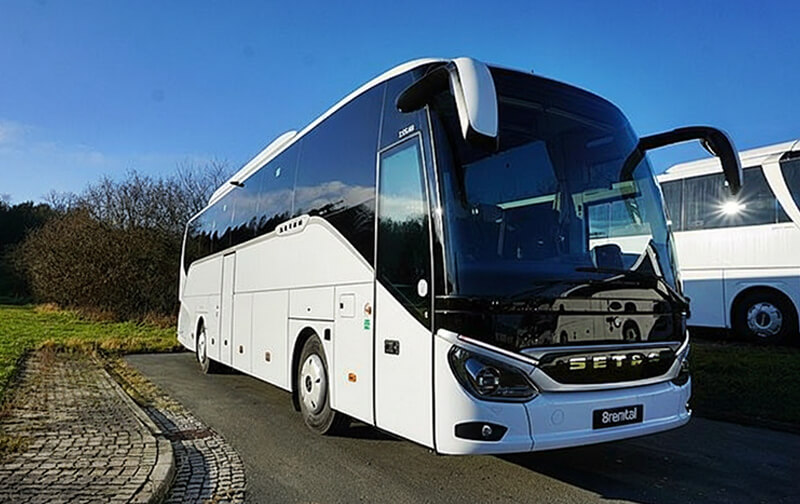
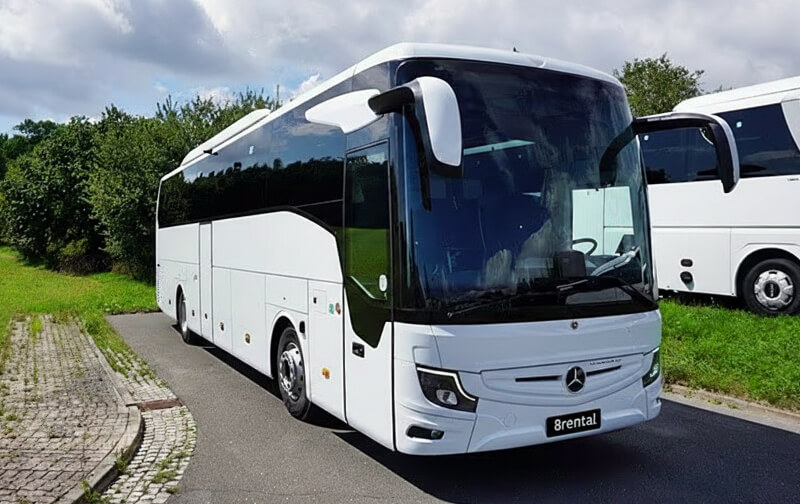
At a glance
- Seats: 49-57
- Luggage: Underfloor luggage lockers
Typical features
- Touring coaches such as the Plaxton Panther are built with 53 or 57 seats and a toilet, or 61 seats without
- Carrying 9 or more passengers for hire or reward makes it a public service vehicle; the operator needs a PSV operator's licence from the Traffic Commissioner
- Driver holds a category D licence (any bus with more than 8 passenger seats); drivers for whom it is the main part of the job need the full Driver CPC, renewed with 35 hours' training every 5 years
- Coaches first used from 1 October 2001 have seat belts on all forward- and rearward-facing seats; passengers aged 14 and over must wear them
- Private hire coach trips within the UK follow the assimilated (ex-EU) drivers' hours rules: 9 hours' driving a day (10 hours twice a week) and a 45-minute break after 4.5 hours
- A tachograph must record driving, breaks and rest; new buses and coaches registered from 24 December 2025 need a full smart 2 tachograph
- PSVAR accessibility rules cover coaches of more than 22 passengers on local or scheduled services, not coaches hired for private trips
Where a big coach cannot go
Size limits the route. York keeps vehicles with more than 16 seats outside the walls. Bristol's Clifton Suspension Bridge is off limits to coaches. Under the Mersey, the 3.5-tonne limit in Queensway sends big coaches through Kingsway instead. In London, the Rotherhithe Tunnel is closed to coaches, and Oxford has set-down bays but nowhere to park in the centre.
Emission standards matter as well. A coach needs Euro VI for London's LEZ, for the Clean Air Zones in Birmingham, Bristol, Bath, Sheffield and Newcastle, and for Scotland's Low Emission Zones.
Licences, belts and hours
A coach taking 9 or more passengers for payment is a public service vehicle, so the operator holds a PSV operator's licence from the Traffic Commissioner. Drivers hold category D entitlement plus a Driver CPC, which needs 35 hours of training every five years to stay valid.
Private hire coach trips within the UK follow the assimilated drivers' hours rules, with a tachograph recording driving, breaks and rest. New coaches registered from 24 December 2025 need a smart 2 tachograph. Every coach on the road since 1 October 2001 has belts at each seat, and anyone aged 14 or over has to wear one.
Questions
Is a full-size coach wheelchair accessible?
Not necessarily. The PSVAR accessibility rules reach coaches used on local or scheduled routes with over 22 passengers; a coach hired for a private trip is outside them. Ask for an accessible vehicle when you book.
When is a midi coach the better choice?
When the group is under about 35, the streets are narrow, or the venue has little room to turn.
Can the coach travel abroad?
Yes. Outside the UK the AETR drivers' hours rules apply, and the operator plans the driver's rest around the ferry or tunnel crossing.
Other charter services
- Coach hire for conferences and company events
- Coaches for school trips and educational visits
- Coach hire for sports teams and away fixtures
- Coaches and minibuses for wedding guests
- Coach and minibus hire for golf trips
- Day trips and tours by coach, with a driver
- Coach transfers to and from cruise ports
- Accessible group transport with a driver